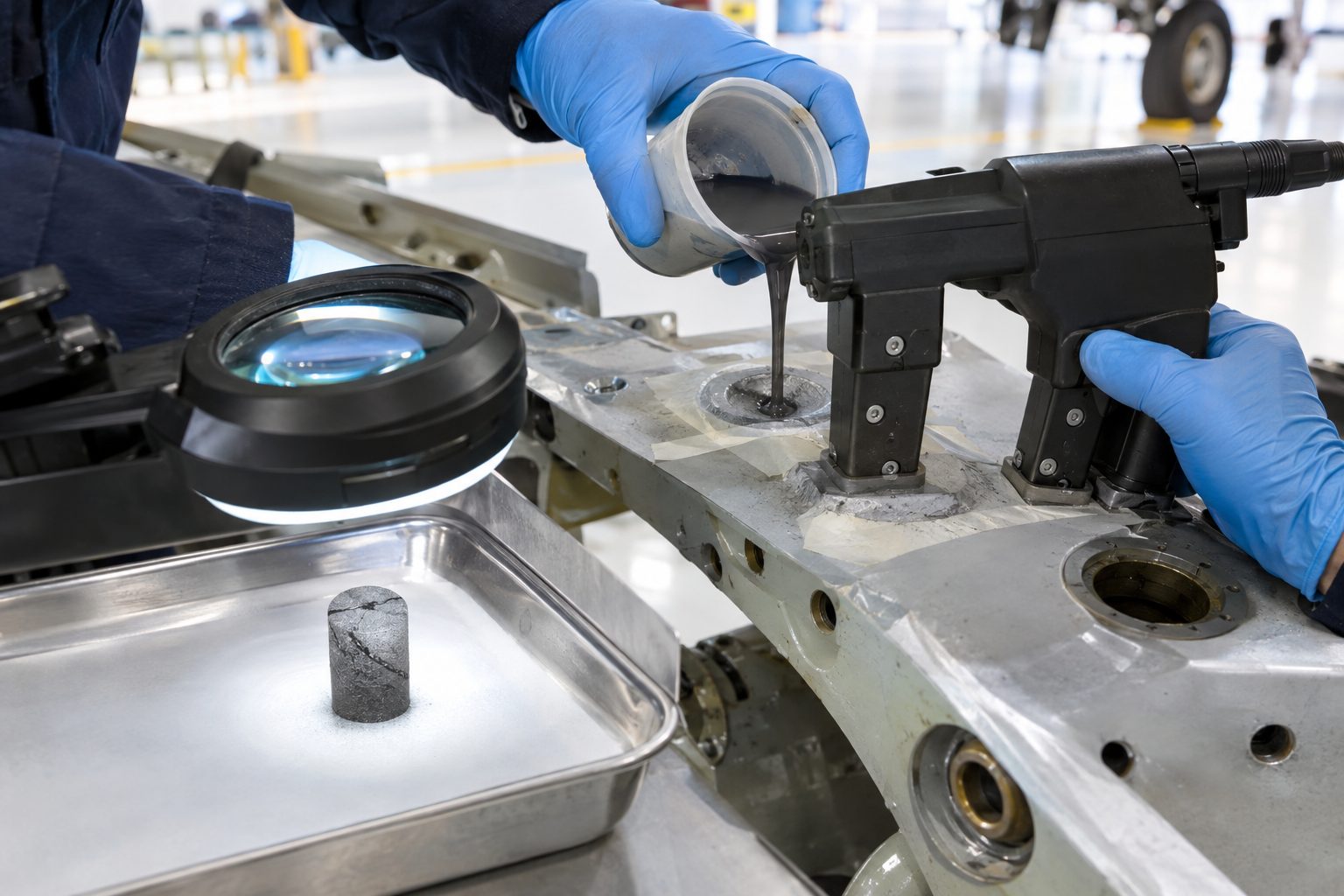
Magnetic rubber inspection (MRI) finds small cracks inside fastener and bolt holes that are hard to reach or see. A liquid silicone rubber filled with fine magnetic particles is placed in the hole, the part is magnetized while the rubber cures, and the solid replica is removed and examined under magnification. CCWI performs MRI on ferromagnetic aerospace and industrial parts to the procedure, drawing or customer specification that applies.
| Document | Use |
|---|---|
| SAE AMS-I-83387 | Inspection process, magnetic rubber |
| ASTM E1444/E1444M | Magnetic particle testing practice, including reference parts |
| OEM and customer specifications | Part-specific technique, magnetization and acceptance criteria |
Magnetic rubber inspection (MRI) is a magnetic particle technique that uses a room-temperature curing silicone rubber filled with magnetic particles. The part is magnetized while the rubber cures, so particles gather at cracks. The cured replica is then examined under magnification.
MRI detects surface and slightly subsurface cracks in ferromagnetic material, especially small fatigue cracks in fastener and bolt holes that are difficult to see or reach.
No. Like all magnetic particle methods, MRI only works on ferromagnetic materials such as most steels. Eddy current or penetrant testing is used on nonferrous holes.
The cured replica is a permanent record of the hole wall. CCWI can return replicas with the report or retain them as the customer specification requires.