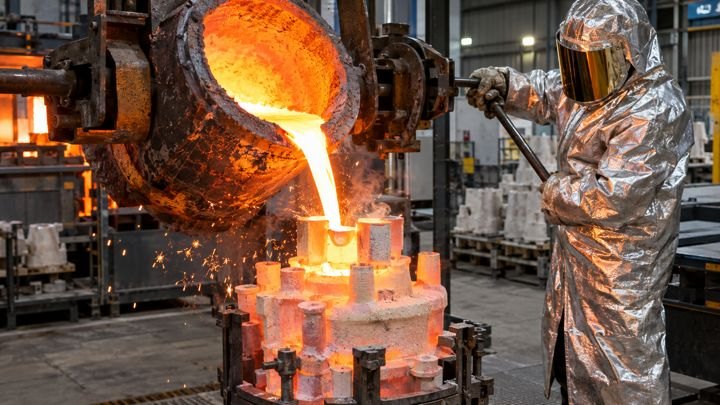
Castings are in our name. CCWI inspects investment castings, sand castings and aerospace engine castings with radiography, CR/DR imaging, fluorescent penetrant and magnetic particle testing, and supports foundries with Level III technique development, film interpretation and audits.
Gas porosity, shrinkage, inclusions, cold shuts, hot tears, cracks, and investment-casting-specific indications such as core breaks, core shift, core kiss-out, residual core and shell buckle. Our free investment casting presentation links each step of the lost-wax process to the indications it can produce.
| Standard | Use |
|---|---|
| ASTM E192 | Reference radiographs of investment steel castings for aerospace applications |
| ASTM E1742 | Radiographic examination practice |
| AMS 2175 | Classification and inspection of castings |
| ASTM E2033 / E2698 | Computed and digital radiography practices |
| ASTM E1417 / E1444 | Liquid penetrant and magnetic particle testing |
Radiography (film, CR or DR) is the primary method for internal casting discontinuities such as porosity, shrinkage and inclusions. Fluorescent penetrant or magnetic particle testing is used for surface-breaking discontinuities.
Yes. CCWI interprets investment casting radiographs against ASTM E192 reference radiographs and the casting class or grade required by the drawing or customer specification.
Yes. CCWI provides ASNT NDT Level III services to foundries, including written techniques, film auditing, procedure review and personnel training.
Yes. CCWI inspects cast aerospace engine components and coordinates neutron radiography with Level III oversight when ceramic core residue must be detected.